✏️ Sentence-by-Sentence Grammar Explanation:
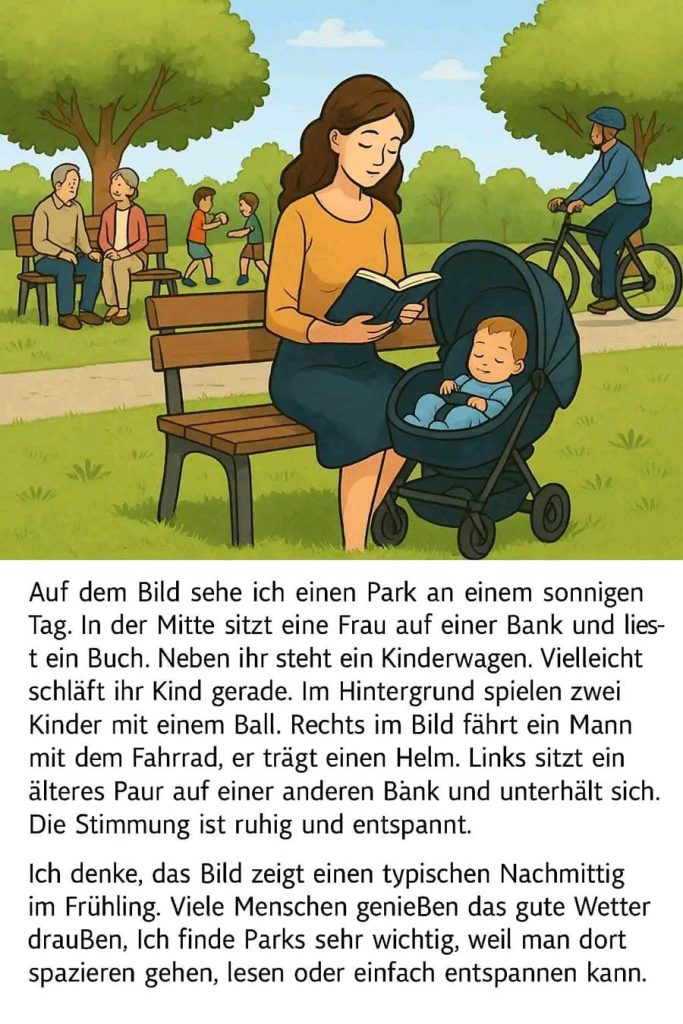
1. “Auf dem Bild sehe ich einen Park an einem sonnigen Tag.”
Auf dem Bild – prepositional phrase (“on the picture”), dative case used with “auf”
sehe ich – Verb comes second due to standard sentence order; subject ich follows verb (V2 rule)
einen Park – accusative case (direct object of “sehen”)
an einem sonnigen Tag – prepositional phrase (“on a sunny day”), “an” + dative
2. “In der Mitte sitzt eine Frau auf einer Bank und liest ein Buch.”
In der Mitte – dative (location), prepositional phrase
sitzt eine Frau – inverted word order due to prepositional phrase first (verb before subject)
auf einer Bank – dative (location)
und liest ein Buch – compound verb structure, coordinating conjunction “und”; liest (verb), ein Buch (accusative object)
3. “Neben ihr steht ein Kinderwagen.”
Neben ihr – dative (location), “neben” + dative here (not movement)
steht ein Kinderwagen – inverted order (verb first due to prepositional phrase start)
4. “Vielleicht schläft ihr Kind gerade.”
Vielleicht – adverb (doesn’t affect word order)
schläft – verb (position 2)
ihr Kind – subject (nominative)
gerade – adverb (currently)
5. “Im Hintergrund spielen zwei Kinder mit einem Ball.”
Im Hintergrund – prepositional phrase (“in the background”)
spielen zwei Kinder – inverted structure (verb before subject)
mit einem Ball – prepositional phrase, dative after “mit”
6. “Rechts im Bild fährt ein Mann mit dem Fahrrad, er trägt einen Helm.”
Rechts im Bild – adverbial phrase, triggers inversion
fährt ein Mann – verb-subject order
mit dem Fahrrad – prepositional phrase (dative)
er trägt einen Helm – new clause with regular word order
7. “Links sitzt ein älteres Paar auf einer anderen Bank und unterhält sich.”
Links – adverb of place
sitzt ein älteres Paar – inverted order
auf einer anderen Bank – prepositional phrase (dative)
und unterhält sich – reflexive verb “sich unterhalten”
8. “Die Stimmung ist ruhig und entspannt.”
Die Stimmung – subject
ist ruhig und entspannt – verb “sein” + predicate adjectives
9. “Ich denke, das Bild zeigt einen typischen Nachmittag im Frühling.”
Ich denke – main clause
das Bild zeigt… – subordinate clause (object of “denke”), accusative object: einen typischen Nachmittag
im Frühling – prepositional phrase
10. “Viele Menschen genießen das gute Wetter draußen.”
Viele Menschen – subject
genießen – verb
das gute Wetter – accusative object
draußen – adverb (place)
11. “Ich finde Parks sehr wichtig, weil man dort spazieren gehen, lesen oder einfach entspannen kann.”
Ich finde Parks sehr wichtig – main clause, “finde” + object + adjective
weil… – subordinating conjunction → verb at the end
man dort spazieren gehen, lesen oder einfach entspannen kann – modal verb “kann” at the end, other verbs in infinitive